
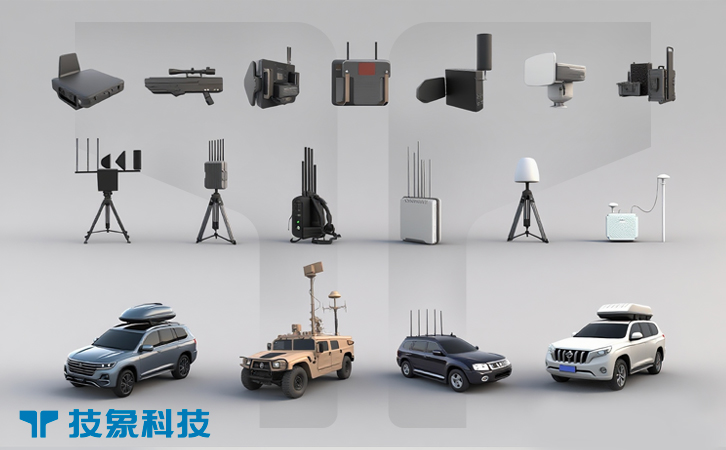
Drone jammers operate on the fundamental principle of Radio Frequency (RF) interference or jamming. Their primary function is to disrupt the critical communication and navigation links between a drone and its operator by emitting powerful, targeted electromagnetic noise. Consequently, the frequency range of a jammer is not arbitrary; it is meticulously designed to match the specific frequencies used by drones for command & control (C2), video transmission, and Global Navigation Satellite System (GNSS) reception, such as GPS .
The effectiveness of a jammer is contingent on its output power being stronger than the legitimate signal at the drone’s receiver, essentially “drowning out” the operator’s commands and satellite signals . This leads to several possible outcomes: the drone may enter a fail-safe mode (like landing or returning to its launch point), lose navigation capability, or have its video feed disrupted .
The frequency spectrum targeted by these systems can be broken down into several key bands:
1. Core Communication Frequency Bands (Most Common Targets)
The vast majority of commercial and consumer drones utilize license-free Industrial, Scientific, and Medical (ISM) bands for their primary communication. Jammers overwhelmingly focus on these:
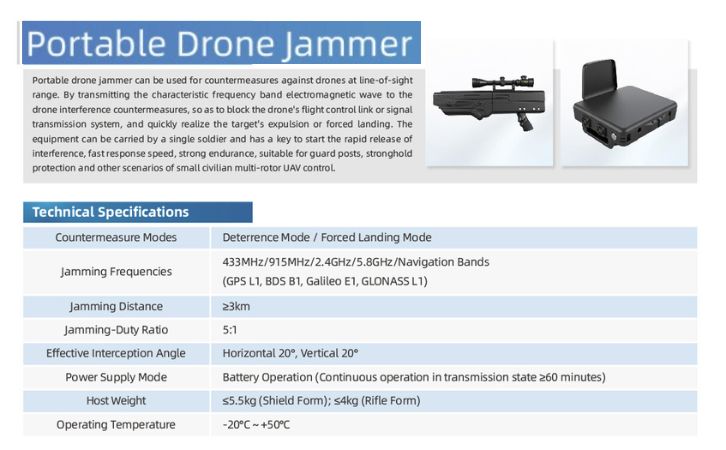
2.4 GHz Band (2400–2500 MHz): This is the most prevalent frequency for drone control and telemetry. It offers a good balance between range and data rate. Because it is also used for Wi-Fi and Bluetooth, drone jammers targeting this band can cause collateral interference to nearby consumer electronics . Technical specifications for jammers like the “Drone 1200” explicitly list “WiFi 2.4: 2400-2500 MHz” as a jamming frequency . Another product specification table lists 2.4G (2400-2500MHz) with high output power .
5.8 GHz Band (5725–5850 MHz / 5150-5875 MHz): This higher frequency band is increasingly used for high-definition video downlink and control, as it provides greater bandwidth and often suffers less congestion than the 2.4 GHz band . It is a standard target for advanced jammers. Product specs confirm jamming ranges like “WiFi 5.8: 5725-5850 MHz” and “5.8G: 5725-5850MHz” . Evidence notes that drones use this band for video transmission, which jammers can disrupt .
These two bands (2.4G and 5.8G) are considered the minimum requirement for effective counter-drone jamming and are featured in nearly all commercial systems .
2. Extended Communication & Control Bands
Beyond the core WiFi-based bands, some drones, particularly for long-range or specialized applications, use other frequencies. Sophisticated jammers are designed to cover these as well:
900 MHz Range (e.g., 863-928 MHz, 915 MHz): Used for extended-range control links, especially in some industrial and older systems . Jamming systems list frequencies like 920MHz and 868-930MHz .
1.2 GHz / 1.3 GHz Bands: Employed in certain professional, long-range, First-Person View (FPV), and hobbyist drone systems .
Lower Frequency Bands (e.g., 433 MHz, 868 MHz): Sometimes used for remote controller links or specific telemetry . Jammers can be customized to include these, with one system listing 433MHz and 868-930MHz as optional channels .
A research summary notes that jammers may target frequencies including “433MHz, 868MHz, 915MHz, 1.2GHz, 2.4GHz, 5.8GHz” . A technical description for a modular system defines a minimal requirement covering “863 to 928 MHz,” “2403 to 2483 MHz,” and “5150 to 5875 MHz” .
3. GNSS/GPS Navigation Frequency Bands
Disrupting a drone’s ability to know its location is a highly effective jamming tactic. Most drones rely on GNSS signals (like GPS, GLONASS, BeiDou) for position holding, autonomous navigation, and “Return-to-Home” functions. Jammers therefore target these satellite frequencies:
GPS L1 Band: 1560–1580 MHz / 1550-1620 MHz: This is the primary civilian GPS signal and a critical target for jammers .
GPS L2 Band: 1170–1280 MHz: Targeted by more advanced jamming systems .
General GNSS Jamming: Evidence frequently refers to jamming “GPS signals” broadly, often at 1.6GHz . One product jams “GPS (L1. L2)” .
By jamming GNSS frequencies, the drone loses its spatial reference, which can cause it to hover in place, drift, or become uncontrollable, thereby neutralizing its threat .
4. Technical Specifications from Commercial Jammers
Reviewing product data sheets provides concrete examples of these frequency ranges in practice:
The “Drone 1200” jammer works on: 2.4 GHz (2400-2500 MHz), 5.8 GHz (5725-5850 MHz), and GPS (1560-1580 MHz) .
A perimeter-mounted jammer covers: 2.4GHz, 5.2GHz, 5.8GHz, and 1.6GHz (GNSS), with options for 433MHz and 900MHz .
A high-power UAV jammer has modules for: 2.4G, 5.8G, GPS L1. GPS L2. 433MHz, and 868-930MHz .
A Drone Deterrence System detects and jams: 920MHz, 2.4GHz, 5.7GHz, 5.8GHz, and GPS (L1. L2) .
A handheld portable jammer effectively jams 2.4G, 5.8G, and GLONASS/GPS signals .
5. Critical Legal and Regulatory Constraints
It is paramount to understand that the operation of drone jammers is heavily restricted or outright illegal in most jurisdictions, including the United States, the European Union, Canada, and Australia . The primary reason is that RF jamming is an indiscriminate technology; signals cannot be selectively targeted. Jamming drone frequencies in the 2.4-5.8 GHz range will inevitably disrupt legitimate Wi-Fi, Bluetooth, and other critical communications in the area . More dangerously, jamming GPS signals can pose severe risks to aviation, maritime navigation, emergency services, and critical infrastructure .
In the United States, the Federal Communications Commission (FCC) strictly prohibits the marketing, sale, and use of jammers by civilians. Authorization is typically limited to specific federal agencies for national security missions . Similar strict regulations exist in the United Kingdom and across other countries . Therefore, while the technical frequency ranges are well-defined, their legal application is reserved almost exclusively for authorized military, law enforcement, and government security operations in controlled settings.