
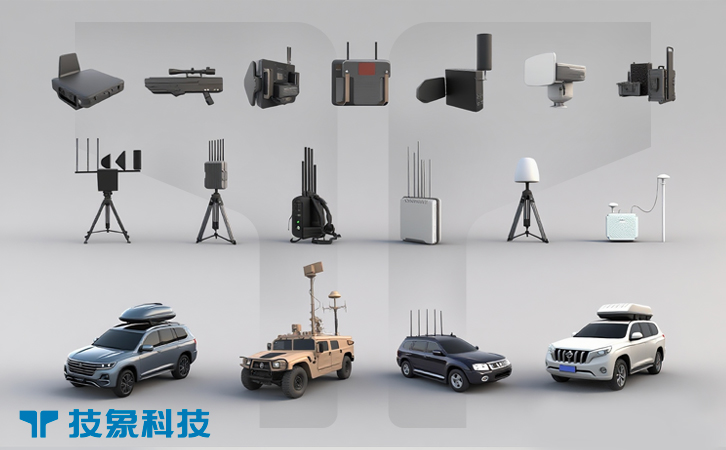
the primary devices designed to disrupt drone signals are Radio Frequency (RF) Jammers, also commonly referred to as drone jammers or signal jamming systems. These devices operate by emitting powerful electromagnetic signals to interfere with the communication and navigation links of unmanned aerial vehicles (UAVs) .
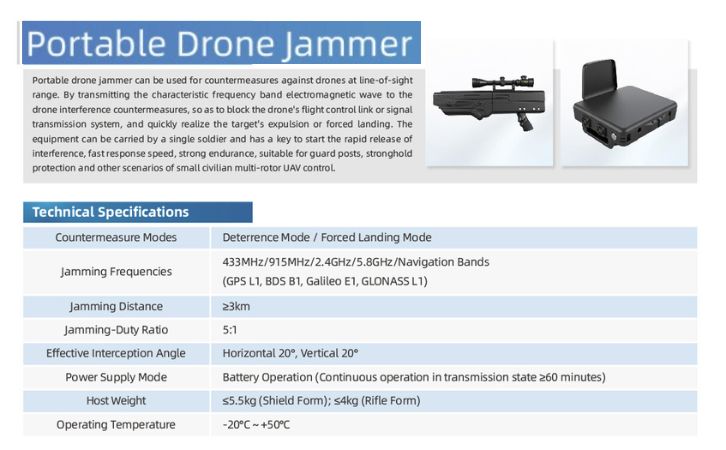
1. Core Device: Radio Frequency (RF) Jamming Systems
RF Jammers are the most prevalent and technically direct method for disrupting drone signals. They function as electronic countermeasure devices .
Primary Objective: Their core purpose is to disrupt the communication link between the drone and its ground control station (operator) and/or to jam its satellite navigation signals (e.g., GPS, GLONASS, BeiDou) .
Basic Principle: They intentionally transmit a high-power RF signal on the same frequency bands used by the drone . This “masking” or overpowering signal creates interference, preventing the drone from receiving legitimate commands from its operator or accurate coordinates from navigation satellites .
2. Forms and Deployment of Jamming Devices
Jammers come in various physical forms to suit different operational needs:
Handheld/Jammer Guns: Portable, rifle-shaped devices that are directional, allowing an operator to aim at a specific drone. Examples include Battelle’s DroneDefender and the ZD-GR030-2000-5 .
Mobile/Portable Systems: Backpack-sized or tripod-mounted units that can be deployed quickly in the field .
Fixed/Static Systems: Larger, more powerful installations designed to protect critical infrastructure like airports, prisons, or government facilities continuously .
Vehicle-Mounted: Jammers installed on vehicles for mobile protection or tactical use .
Integrated Counter-UAV Systems: Jammers combined with detection systems (e.g., radar, radio frequency scanners) for automated threat response. Systems like DroneShield fall into this category .
3. Technical Operation and Effects on Drones
The disruption process is technically nuanced and leads to specific drone behaviors:
Targeted Frequencies: Modern jammers are typically multi-band, covering frequencies such as:
900MHz, 1.5GHz: Used for some control and telemetry links .
2.4GHz & 5.8GHz: The most common bands for consumer and commercial drone control and video transmission (First-Person View – FPV) . Jamming the FPV channel disables the operator’s video feed and maneuvering capability .
GPS L1. GLONASS, etc. (∼1.5-1.6GHz): Satellite navigation bands . Jamming these disrupts autonomous flight modes .
Resulting Drone Behavior: The outcome depends on the drone’s pre-programmed fail-safe protocols. Common reactions include:
Return-to-Home (RTH): The drone autonomously flies back to its recorded take-off point .
Controlled Landing: The drone lands immediately at its current position .
Hover: The drone loses command input and simply hovers in place until its battery depletes .
Uncontrolled Crash: In less sophisticated systems, the loss of signal can cause an immediate, uncontrolled descent .
Flyaway: The drone may fly off in a random, uncontrolled direction .
Effectiveness Range: This varies significantly with device power and environment. Commercial systems often cite effective ranges from 100 meters up to 2 kilometers or more .
4. Other Signal Disruption Methods (Beyond RF Jamming)
While RF jamming is dominant, the materials mention other technologies:
GPS/GNSS Spoofing: A more sophisticated attack that broadcasts fake satellite signals to trick the drone’s navigation system into believing it is somewhere else, potentially guiding it to a different location .
Radio Hijacking: Attempting to intercept and take over the control signal itself to commandeer the drone .
High-Power Microwave (HPM) / Electromagnetic Pulse (EMP): Devices that generate a powerful electromagnetic pulse capable of damaging or disrupting the drone’s internal electronics .
Acoustic Interference: Targeting the drone’s MEMS gyroscope with resonant sound waves to disrupt its flight stability .
5. Examples of Commercial Drone Jamming Devices
The materials provide several real-world examples:
UAD-GQ03: A commercial portable jammer operating on 2.4GHz and 5.8GHz with a range up to 1 km .
DroneDefender (by Battelle): A lightweight, handheld, directional jammer that causes drones to hover, land, or return home .
KEAS MinKa / MinKam: Fixed and mobile jammer systems from France that cover all commercial drone and GNSS frequency bands .
Repulse 24: A UK-based unit for installation on aircraft or ground vehicles, primarily jamming the 2.4GHz band .
ZD-GR030-2000-5: A handheld jammer with 30W power covering five bands (including GPS, 2.4GHz, 5.8GHz) and a range of at least 1500 meters .
Argus-5000. SkyHunter-4M/P, Volnorez: Cited as examples of fixed, static, and portable jamming systems, respectively .
6. Critical Legal and Regulatory Framework
This is a paramount consideration. The use of signal jamming devices is heavily restricted or outright illegal in most jurisdictions for non-state actors.
General Legal Status: The neutralization of drones using jammers is, in most countries, not legally permitted for private entities and is a subject of ongoing regulatory debate .
United States: The Federal Communications Commission (FCC) strictly prohibits the marketing, sale, and operation of jammers that interfere with authorized communications, which includes drone frequencies. Violations can result in severe fines and imprisonment .
Exceptions: Authorized use is typically reserved for military, law enforcement, and government security agencies under specific conditions for national security and public safety operations .
European Union & Other Countries: Similar stringent regulations exist in the EU, Canada, and Australia, where the use of jammers is generally banned for civilians due to risks of disrupting critical communication services (e.g., emergency calls, aviation, cellular networks) .
Responsible Use: Any potential deployment must be preceded by thorough research and compliance with all local, national, and federal laws to avoid significant legal consequences .
In summary, the device designed to disrupt drone signals is fundamentally a Radio Frequency Jamming System. These systems are highly effective and come in various forms, from handheld guns to fixed installations. However, their operation is tightly controlled by law, and legitimate use is almost exclusively confined to authorized government and military personnel due to the significant risks of collateral interference with essential communication networks.