
An anti-drone jammer, also known as a Counter-Unmanned Aircraft System (C-UAS) jammer or drone frequency jammer, is an electronic warfare device designed to detect, disrupt, and neutralize unmanned aerial vehicles (UAVs) by emitting targeted radio frequency (RF) signals. Its primary function is to protect sensitive airspace by interfering with the critical communication links a drone relies on for operation, thereby preventing potential threats such as espionage, smuggling, payload delivery, or collisions .
Core Technological Principle and Operation
The fundamental working mechanism is based on Radio Frequency (RF) Jamming. These devices function by transmitting powerful electromagnetic noise or signals on the exact frequencies used by drones for command, control, and navigation .
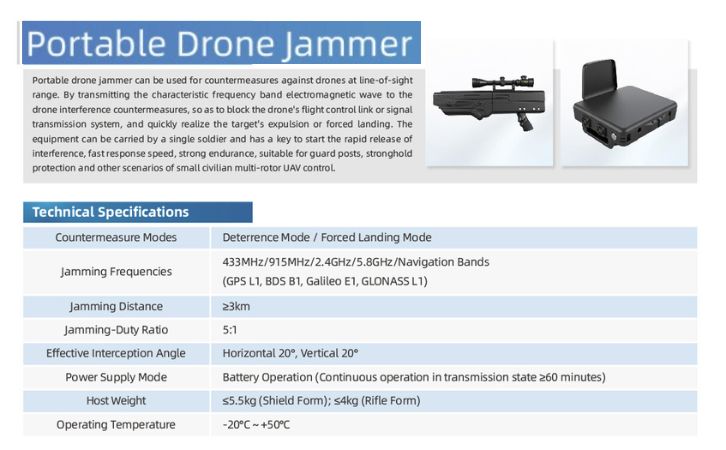
Targeted Frequencies: Most commercial and consumer drones operate on unlicensed, public frequency bands, predominantly 2.4 GHz and 5.8 GHz, which are used for the remote controller link and, often, for video transmission . More advanced systems also target frequencies used for Global Navigation Satellite Systems (GNSS/GPS), such as 1.2 GHz, 1.5-1.6 GHz, and others, to disrupt positioning .
Jamming Effect: The jammer’s transmitted signal overwhelms the receiver on the drone, “drowning out” the legitimate signals from its operator . This causes one or more of the following effects:
Break in Control Link: The drone can no longer receive new commands from its pilot, leading to a loss of control .
Disruption of Navigation: By jamming GPS signals, the drone loses its ability to accurately determine its position, which can corrupt its flight path or hover stability .
Initiation of Safety Protocols: A very common outcome is the activation of the drone’s built-in fail-safe routine. When the control signal is lost, many drones are programmed to automatically Return-to-Home (RTH) or execute an immediate landing on the spot . This specific response can also aid security personnel in tracking the drone back to its point of origin to locate the operator .
Physical Forms and System Integration
Anti-drone jammers come in various form factors to suit different tactical needs:
Handheld/Anti-Drone Guns: These are portable, rifle-shaped devices that project a focused jamming signal in a cone-shaped beam (typically 15-30 degrees), allowing an operator to precisely target a single drone . They are ideal for mobile security teams and rapid response.
Mobile and Fixed Station Systems: Larger systems can be vehicle-mounted or installed at permanent sites (e.g., around a perimeter). These often have greater power, range, and may incorporate omnidirectional antennas to create a 360-degree protective “umbrella” or “dome” over a wide area .
Integrated C-UAS Suites: Modern systems are rarely standalone jammers. They are increasingly part of a layered defense system that includes detection technologies (e.g., radar, RF scanners, electro-optical sensors). The detection system first identifies and tracks a drone threat, then cues the jammer to engage it automatically or with human oversight, creating a comprehensive “detect-and-neutralize” solution .
Primary Applications and Use Cases
The deployment of anti-drone jammers spans civilian, government, and military sectors to address growing UAV threats:
Military and Defense: Protecting forward operating bases, military installations, and high-value assets from surveillance, terrorist attacks, or weaponized drones .
Critical Infrastructure Security: Safeguarding facilities like power plants, oil refineries, telecommunications hubs, and government buildings from espionage or sabotage .
Aviation Safety: A critical application is securing airspace around airports and helipads. Systems are deployed to monitor clear zones and neutralize drones that pose a catastrophic risk of collision with manned aircraft .
Public Event and VIP Protection: Ensuring safety at large gatherings, stadium events, political rallies, and for dignitaries by preventing unauthorized drone flights that could be used for surveillance or as attack platforms .
Law Enforcement and Correctional Facilities: Used by police to secure crime scenes or major events and to prevent drones from smuggling contraband into prisons .
Limitations and Ethical/Legal Considerations
While effective, the technology has constraints:
Collateral Interference: RF jammers are not perfectly selective. Their signals can potentially disrupt legitimate communications in the same frequency band within their range, such as public Wi-Fi, Bluetooth devices, or even other critical services, leading to significant “collateral damage” .
Precision and Effectiveness: The effect on a drone depends on its programming, the strength of the jamming signal, and environmental factors. Some drones may behave unpredictably when jammed .
Legal Restrictions: The use of RF jamming equipment is highly regulated and illegal for private or unauthorized use in many countries, including the United States and most of Europe. Jurisdictions typically reserve legal use for government, military, and specific law enforcement agencies . Furthermore, jamming a drone in flight, which could cause it to crash, may carry legal liability.
In conclusion, an anti-drone jammer is a pivotal non-kinetic countermeasure in modern security arsenals. It operates by electromagnetically suppressing a drone’s control and navigation channels, forcing it into a safe state. As drone technology proliferates, these systems continue to evolve, integrating more sophisticated detection and AI-powered targeting to mitigate their inherent limitations and provide reliable protection for increasingly vulnerable airspace .