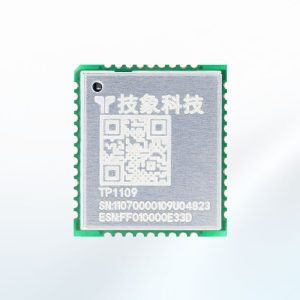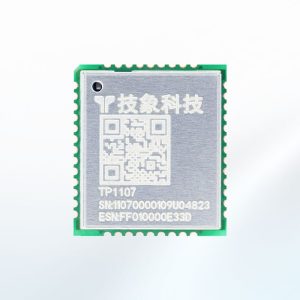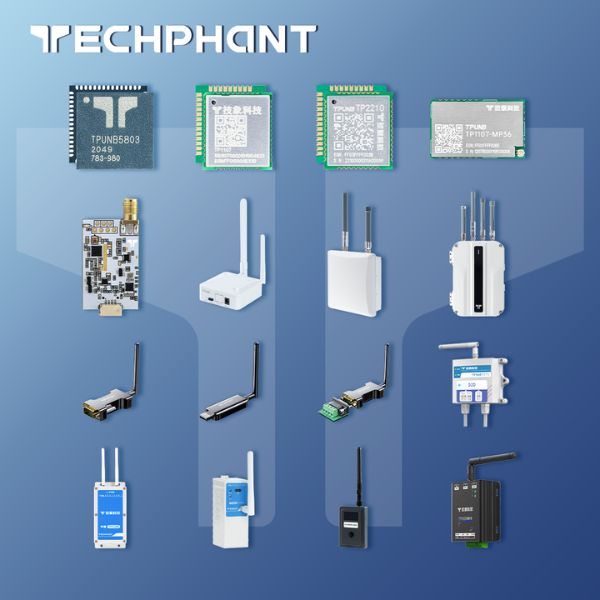
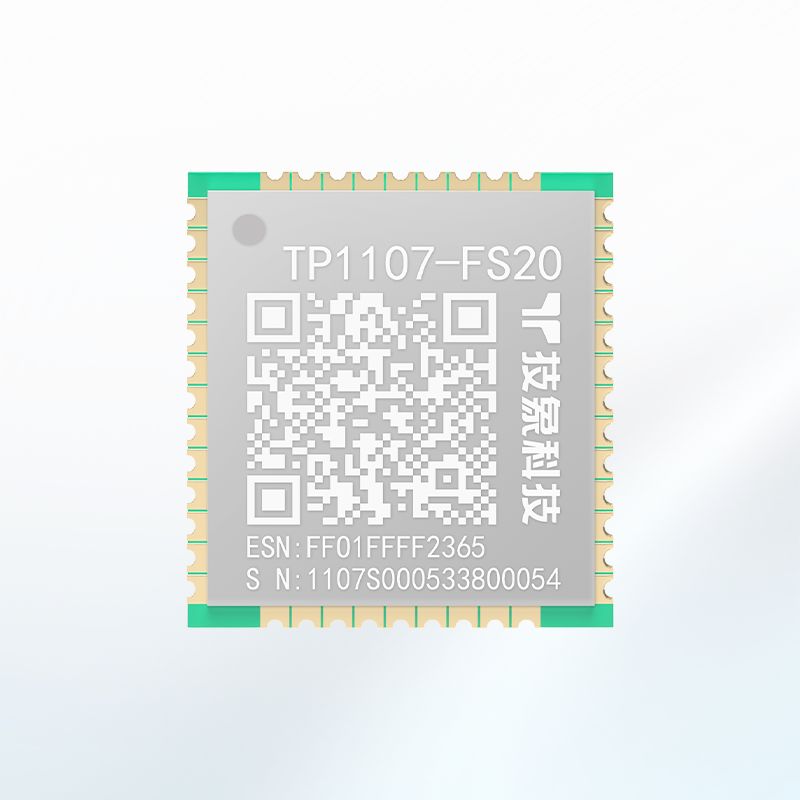
TP1107-FS20 is a high-performance industrial-grade wireless communication terminal module launched by Jixiang Technology, built on TPUNB low-power wide-area communication technology, designed for mission-critical applications. It can adapt to the deployment needs of multi-scenario IoT, and combines the advantages of flexibility, low power consumption, high reliability and easy integration.
In terms of networking capability, TP1107-FS20 supports highly flexible topology configuration, and is compatible with three mainstream networking modes: star network, mesh ad-hoc network and point-to-point network. In star networking scenarios, it can be paired with the TP2210 gateway to build a local star network, or with the TP2108 gateway to build a cloud-connected network. The basic mode can communicate with 5 terminals within 1 second, and the high-capacity mode can support a single gateway to connect 20 terminals within 1 second, meeting the deployment requirements of sensor networks of different scales. The point-to-point networking mode supports direct connection at 470MHz/490MHz/510MHz multiple frequency bands, and the Bluetooth-enabled version supports device configuration and firmware upgrade without opening the casing, which greatly reduces the difficulty of on-site maintenance. It also supports intelligent relaying and mesh networking, can adapt to complex terrain and large-area coverage scenarios, solve the coverage problem caused by signal occlusion, and supports LBT/RSSI spectrum detection to further improve communication stability. The module itself also supports broadcast and targeted over-the-air wake-up, which can effectively avoid signal crosstalk. Combined with remote OTA firmware upgrade capability, the efficiency of batch equipment operation and maintenance is greatly improved.
Low-power design is the core advantage of TP1107-FS20, which is deeply optimized for battery-powered passive deployment scenarios. The operating current of the module in low-power mode is only 2μA, the current in OTA wake-up mode is as low as 18μA, and the sleep current with RTC enabled is only 2.2μA @3.3V. Compared with traditional LoRa solutions, the TPUNB technology carried by TP1107-FS20 can achieve a maximum air interface transmission rate of 76.8kbps, which is much higher than the conventional 19.2kbps of LoRa. With the same traffic, the module’s battery utilization can reach 90%, which is much higher than 40% of traditional LoRa solutions. It can greatly extend the battery life after device deployment, achieve several years of work with one battery replacement, and reduce long-term operation and maintenance costs.
In terms of core communication performance, TP1107-FS20 has a receive sensitivity of -115dBm. Combined with S-FSK modulation technology, it has excellent wall-penetrating and diffraction capabilities, can achieve ultra-long-distance communication, and meet the needs of long-distance transmission in open outdoor scenarios and penetration transmission in complex indoor buildings. At the same time, for the security requirements of key applications, the module has a built-in full-link security mechanism, supports secure encryption, and has multiple security capabilities of anti-cracking, anti-data leakage and anti-tampering, which can meet the application requirements of high-security scenarios such as power meter reading, municipal facilities, and industrial monitoring. The module itself supports industrial-grade operating temperature from -40℃ to +85℃, can adapt to low temperature, high temperature and other harsh environments, with guaranteed reliability.
In terms of hardware integration design, TP1107-FS20 adopts a 44-pin LCC SMT surface-mount package, with leadless design and small size, only 17.7mm×15.8mm×2.0mm, which is easy to integrate into various small terminal devices. At the same time, the module reserves rich hardware interfaces, including AT command serial port, debugging serial port, wake-up signal, network status indication, etc., which can quickly adapt to the hardware design requirements of different customers and shorten the product development cycle.
At present, this module can be widely used in many low-power wide-area IoT scenarios such as smart meter reading, environmental monitoring, smart parking, industrial sensor data collection, and smart city facility monitoring, and is an ideal communication module choice for high-demand IoT projects.